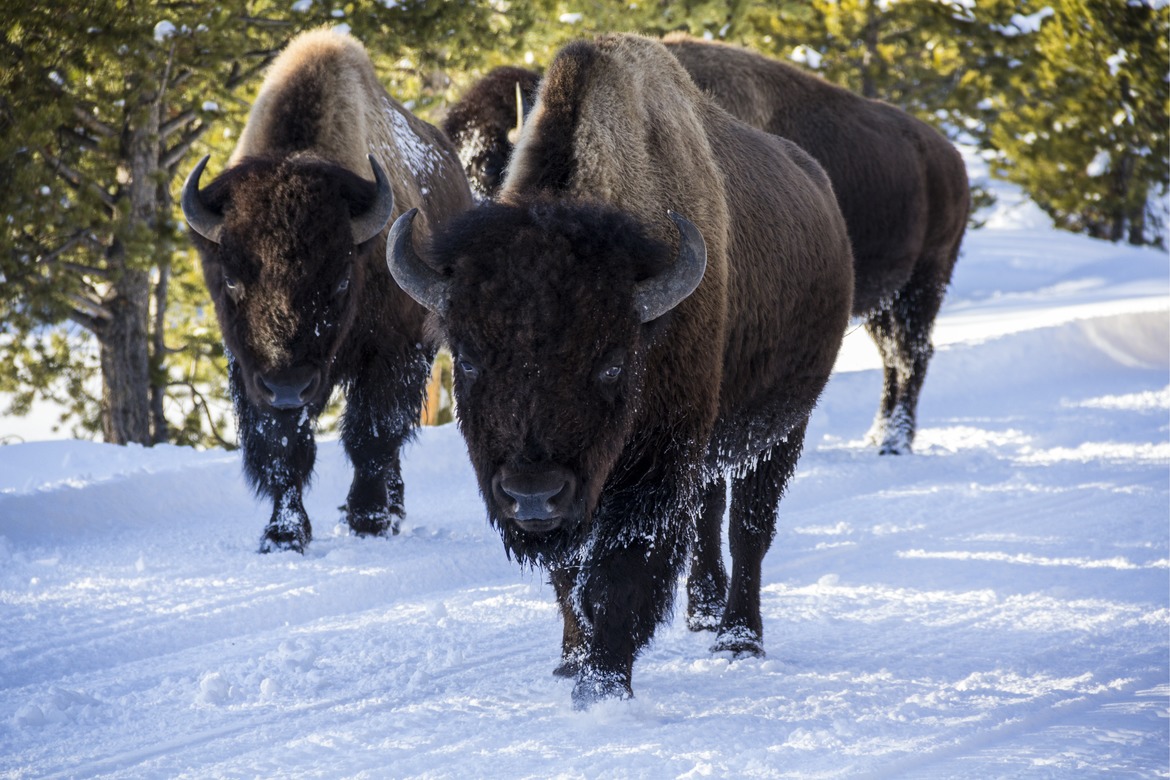
Eye Contact
Species: American Bison | Location: Yellowstone National Park, United States of America
By Andy Meislin
American Bison inspire conservation efforts. An estimated 20 to 60 million bison once roamed across North America. The population dipped as low as 325 individuals in the 1800's, but due to conservation efforts, the population today has risen to approximately 30,000 in conservation herds and 500,000 in captivity. Although a great success story, American Bison are still a "conservation dependent" species according to the IUCN Red List, meaning that if land management tactics change, the species could decline rapidly. This photograph is part of a larger series, Higher Up the Mountain, which, through the context of winter, explores mountain life, climate change, and conservation.
About The Photographer

As a graduating senior at Stanford, majoring in both Human Biology and Art Practice, I think a lot about the intersection of art and science. I see both of my fields as connected because in both I explore my curiosity about the natural world. Through my artwork, I am more deeply engaged with the world around me, and I am able to more meaningfully reflect upon my place in it. Photography is the main medium I work in to explore my environment, and I have been practicing photography since I was 15 years old, and my art practice has been evolving since then. I started my photographic practice in my high school’s dark room with 35mm film. Beginning with film taught me to be extremely thoughtful in which photographs to take and how to frame them because of the limited space on a roll. At the end of high school and the beginning of Stanford, I took additional film photography classes that introduced me to 120mm film and alternative dark room processes. In my last two years at Stanford, my photographic practice expanded to include digital photography. My senior capstone, a photographic book, Higher Up the Mountain, explores climate change in winter landscapes, and was taken with a combination of two different digital cameras, a Canon EOS 60D and Olympus TG-4. I hope that my viewers see my work and are able to reflect upon the time and space in which it was created, and how that environment changed or will change in the seconds, hours, months, or years after the photograph.